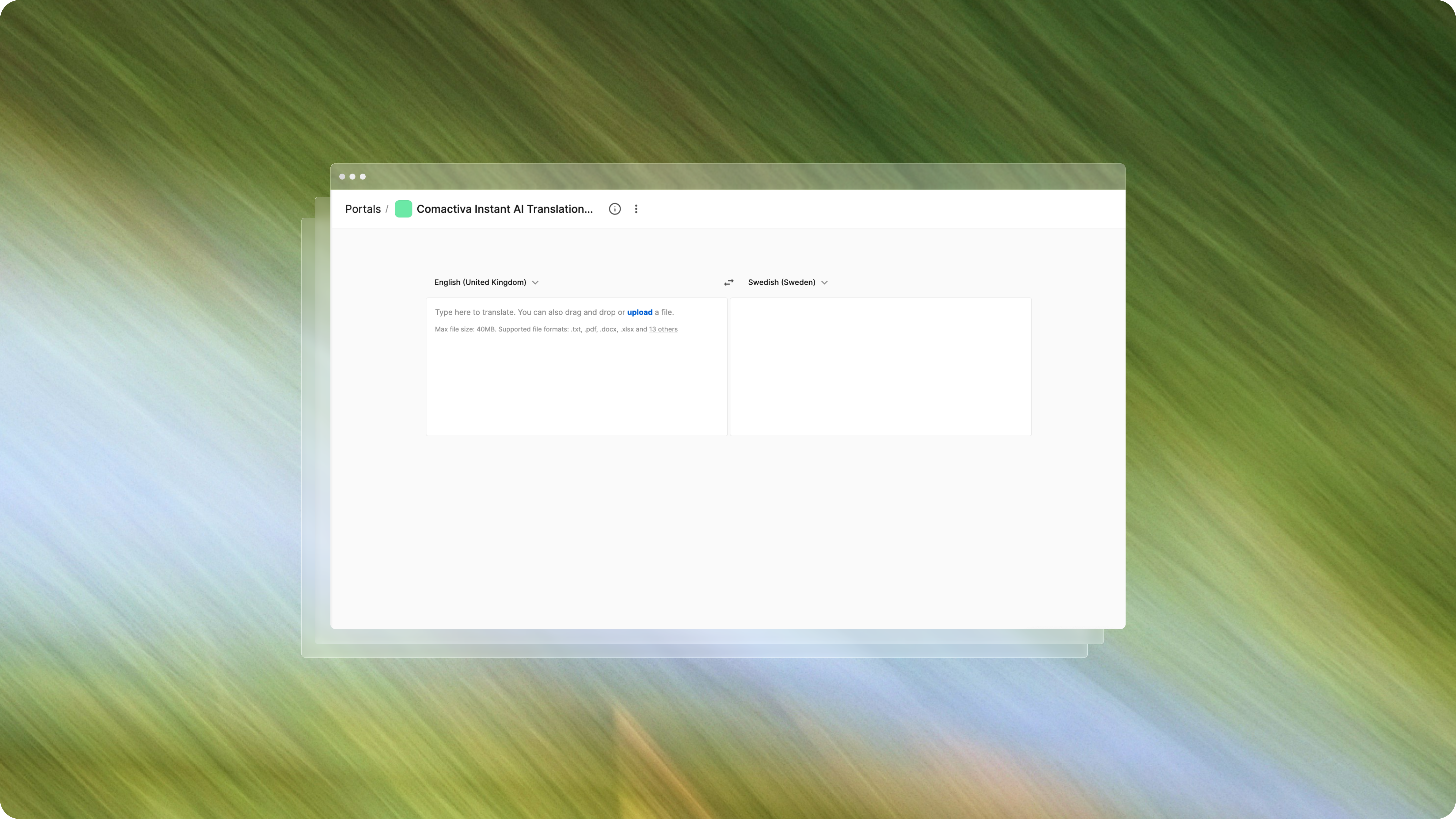
New Feature: Human Review Directly From Your Translation Tool
 Sofia Johansson: Mar 30, 2026 4:01:45 PM
.png)
EU’s new Machinery Regulation, Regulation (EU) 2023/1230, replaces the Machinery Directive and will apply in full from 20 January 2027. The regulation modernizes the regulatory framework for machinery and machinery-related products and introduces significantly clearer requirements for safety, documentation, digital information, and allocation of responsibilities throughout the product’s entire lifecycle.
For manufacturing companies, this means that language versions, information flows, and internal processes need to be more structured than before.
One of the most important changes is that safety-related documentation must be available in the official language of the country where the product is sold. This applies not only to traditional manuals, but also to digital instructions, software interfaces, and other risk-related information.
This means that companies need to gain better control over how content is created, updated, and translated. Terminology, safety wording, and different language versions must be consistent and kept synchronized over time.
When information is spread across multiple systems and handled by different teams, the risk of variations, manual corrections, and time-consuming validation increases. Many organizations already find it challenging to keep workflows aligned and ensure that all versions are based on the same source information.
The Machinery Regulation enables the use of digital documentation, including digital manuals and machine-readable formats. At the same time, language requirements are tightened and the allocation of responsibilities is clarified for manufacturers, importers, and distributors.
Requirements for traceability and information management are also increasing. It is not only about what is documented, but about how content is created, updated, and kept consistent throughout the product’s entire lifecycle.
The Regulation also means that all safety-related documentation, from manuals to digital instructions, software interfaces, and risk information, must be accurate, consistent, and available in the correct language. This requires better control over how content is produced, updated, and translated.
When information is spread across multiple systems and handled by different teams, the risk of variations, manual corrections, and time-consuming validation increases. It therefore becomes more important to work from a clear strategy and a cohesive structure, ensuring that content, language versions, and workflows remain aligned over time.
As digital documentation becomes the norm, new opportunities emerge to use AI-based translation tools as a natural part of the documentation process.
Many companies have already started testing AI, but often in smaller, isolated initiatives. As a result, the technology can end up taking more time than it saves, especially when each team works in its own way and validation still has to be done manually.
When AI is instead used within a cohesive process and connected to existing systems, such as CCMS, PIM, PLM, or service platforms, it has a very different impact. Content can be reused more systematically, validation can be carried out in a more controlled way, and terminology can be kept consistent over time.
This creates the conditions for faster publishing, fewer errors, and better control over all language versions.
Manufacturing companies often manage large volumes of product information across multiple parallel systems. When documentation and translations take place in separate workflows, it becomes difficult to maintain a coherent whole, which impacts both quality and costs.
Integrated processes make it possible to:
A more integrated way of working makes it easier to meet the requirements of the Machinery Regulation, while reducing the need for manual checks and corrections.
There is no universal solution. For some organizations, a translation management system (TMS) is a natural step toward creating structure in workflows and terminology management.
However, a TMS rarely solves the entire challenge on its own. Implementation, maintenance, and ongoing optimization require internal resources. In addition, there remains a need for specialist expertise to ensure that safety-related information, tone of voice, and terminology truly work across all markets.
Other companies operate in a more distributed way, using multiple tools and suppliers. This can provide flexibility, but it often makes it harder to maintain quality, reuse content, and manage validation consistently over time.
As requirements for documentation, language versions, and traceability increase, it is rarely sufficient to start by choosing tools or defining a strategy right away.
For many manufacturing companies, the next step is rather to first create a clear picture of how work with product information actually functions in practice, how content is created, updated, and shared across different teams and systems, where responsibility lies; where manual steps occur, and how terminology and different versions are kept aligned over time.
Only when the current situation becomes clear is it possible to determine what the organization actually needs and which strategy is relevant to build on.
Here, an external partner can contribute methodology and an outside perspective to help structure the work and identify where improvements will have the greatest impact.

Annica Zamora Heuermann from Comactiva and Jonas Härdner from Simonsoft are hosting a focused session where you can explore the details and ask your questions.

 Sofia Johansson: Mar 30, 2026 4:01:45 PM
 Simon Giulja Ahl: Mar 30, 2026 4:01:33 PM

 Linda Gårdlöv: Mar 30, 2026 4:01:23 PM